
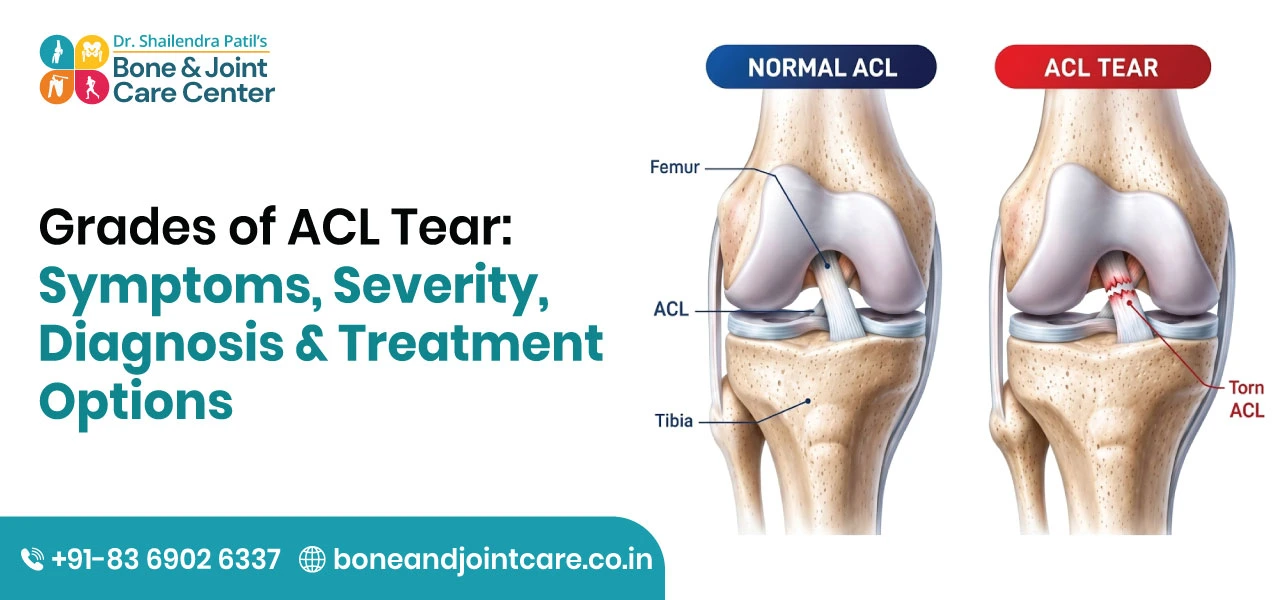
The ACL tear has three grades that show how much the ligament has sustained damage and how well it can stabilize the knee joint. Grade 2 indicates a partial tear, with Grade 3 representing a completely torn ligament.
Grades of ACL Tear: Symptoms, Severity, Diagnosis & Treatment Options
Your Anterior Cruciate Ligament (ACL), one of the four crucial ligaments, plays an integral part in keeping your bones stable as you move, run, walk, or change directions. It controls excessive twisting of the knee. An injury during physical activities or a sudden change of direction can tear the fibers of this ligament.
A knee specialist in Mumbai grades an ACL tear based on the damage to the ligament and the surrounding structures. Let’s understand how an ACL tear is graded.
Grading ACL Tear
Let’s understand the grading system in detail.
Grade 1: Mild Sprain
This happens when your ligament stretches farther than its limit, causing microscopic tears and a mild sprain. The ligament stays in one piece and can still stabilize your knee.
Symptoms
- Pain when fully bending or straightening the affected knee
- Tenderness
- Mild swelling
- Some difficulty during movements, especially when putting stress or weight on the affected leg
- Mild stiffness that can be mainly felt in the morning
- No pop sound
Treatment
The injury is usually manageable without surgery. Since the ligament isn’t completely torn, the treatment and recovery are usually simple and short. Here’s what may help:
- Resting
- Ice packs to control swelling
- Compression stockings
- Elevation
- Pain-relief meds
- Physiotherapy to regain your joint movements
Putting strain on the affected knee can sometimes worsen the damage. So, avoid continuing sports until the ACL is healed.
Grade 2: Partial Tear
A grade 2 ACL tear happens when the ligament is stretched enough to tear some of its fibers, while the others might be intact. So, the ligament isn’t completely torn, but gets weaker. While it can provide some stability to your knee, it may not be fully effective or function as usual.
Symptoms
- Moderate knee pain, which may feel worse as you move the affected joint
- Swelling
- The affected knee can’t bear weight
- A small pop sound at the time of injury
- Difficulty climbing stairs or changing directions
- A sensation that your knee might “give way”
Treatment
The injury is more severe than a mild sprain, with many people struggling to perform daily movements. However, since the ligament is still in place, the knee joint retains some of its functions. Treatment mainly includes:
- Limiting activities
- Using the RICE approach for managing swelling
- Physiotherapy
- Knee bracing
You may continue treatment, especially physiotherapy, for 3-4 months. If your knee still feels unstable or its function hasn’t improved much, an orthopedic surgeon may discuss a surgical ACL reconstruction.
Grade 3: Complete Tear
A grade 3 tear is when the ligament is completely torn and can no longer support your knee movements.
Symptoms
- A popping sound right after sustaining the injury
- Sudden and debilitating knee pain
- Significant swelling that develops within the first few hours of the injury
- Difficulty moving the knee
- A feeling that your knee is “giving way”
Treatment
While physiotherapy and knee bracing can provide some support, many patients are advised to undergo surgical reconstruction to restore full range of motion and knee stability. See an orthopedic surgeon to know ACL surgery cost in Mumbai and procedure details.