
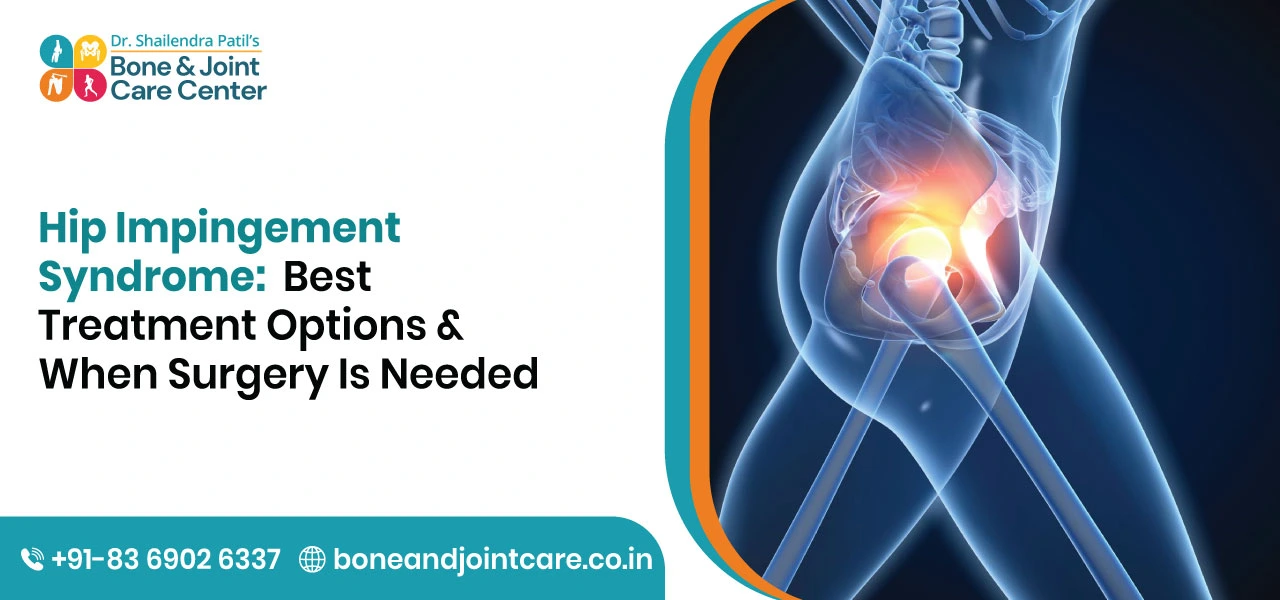
Hip impingement syndrome happens when there’s an unusual bump on the ball or socket of your hip joint, or when they are abnormally shaped, causing joint stiffness and pain during movement.
Hip Impingement Syndrome: Is Surgery Necessary?
Hip impingement syndrome, also called femoroacetabular impingement (FAI) syndrome, occurs when abnormally shaped bones or extra bones don’t fit together, causing them to rub against each other when you move your hip.
It doesn’t always require hip replacement surgery in Mumbai. An orthopedic doctor may start treatment conservatively before considering more invasive approaches for persistent and severe hip pain associated with FAI. To understand how it occurs, let’s first discuss how a hip joint works.
Understanding Hip Impingement Syndrome
In your hip joint, the rounded portion of the thigh bone, also called the femoral head, fits snugly into the socket (acetabulum). These bones glide smoothly during hip movements.
In people with hip impingement, an extra bone growth either in the ball or socket can lead to friction during movements. Repeated movements can cause frequent rubbing of these bones, which can eventually damage the labrum—a soft ring of tissue cushioning your hip joint.
Symptoms of Hip Impingement Syndrome
Here’s what people with Hip Impingement Syndrome feel:
- Stiffness in the hip joint
- Pain during certain movements
- Limited mobility
- Limping
For some, it’s a dull ache that’s felt deep in the groin or front of the hip. Others describe it as a sharp pinching sensation. The pain might get worse when you sit for longer periods, squat, climb stairs, lie on your side, run, or do exercises (especially the ones that involve bringing your knees toward the chest). However, some may have an abnormal bone shape associated with FAI but experience no symptoms at all.
Types of Hip Impingement Syndrome
Some people are born with FAI, while others may develop it later in life due to activities that put repeated stress on the hip joint. These are classified into the three common types:
- Cam Impingement: The rounded portion of the femoral head, which fits into the socket, may be of unusual shape or have an extra bump. When you move the joint, this bump can rub against the socket, causing stiffness and pain.
- Pincer Impingement: Unlike cam impingement, the problem here is in the socket rather than the femoral head. The extra bone growth in the socket, or the socket covering a larger portion of the ball than it normally does, can cause friction during movements.
- Combined Impingement: This one combines both: extra bone growth on the ball, as well as a socket covering the ball excessively, thus causing both to rub against each other.
Treatment for Hip Impingement Syndrome
Common treatment options for FAI include:
Medication: Your healthcare provider may prescribe anti-inflammatory drugs or pain-relieving medication to help manage pain. In some cases, the doctor may inject corticosteroid injections to provide short-term pain relief.
Physical Therapy: A physiotherapist can help you practice exercises that improve your hip flexibility and strengthen the core muscles around your hip joint.
Surgery is needed when the FAI has caused severe damage to the cartilage or has significantly restricted your mobility. If needed, a hip replacement surgeon in Mumbai may perform hip arthroscopy to remove the excess growth and repair the shape of the hip joint.